What are dental sealants and why are they important?
We all know that thorough daily dental hygiene is essential for avoiding dreaded tooth decay. To achieve this, it is important to brush your teeth and use dental floss, but sometimes brushing cannot fully clean every space between the teeth.
To prevent decay in both baby teeth and permanent teeth, the teeth can be sealed – an innovative, revolutionary technique that is non-invasive and painless.
What are dental sealants?
Fissure sealing is a modern, safe and effective procedure used to reduce the risk of decay in the grooves and deeper areas of the permanent teeth, which are often difficult to clean. Fissure sealing is especially recommended for children.
Why is fissure sealing important?
Children are at risk of developing tooth decay because they often don’t clean their teeth properly and they love eating sweets. Around the age of 6, the permanent teeth start to come through, including the first molars. These teeth have grooves (fissures) and pits where bacteria can begin to act, making decay more likely. A simple, painless procedure for preventing decay is fissure sealing, which gives these areas extra protection.
How is fissure sealing carried out?
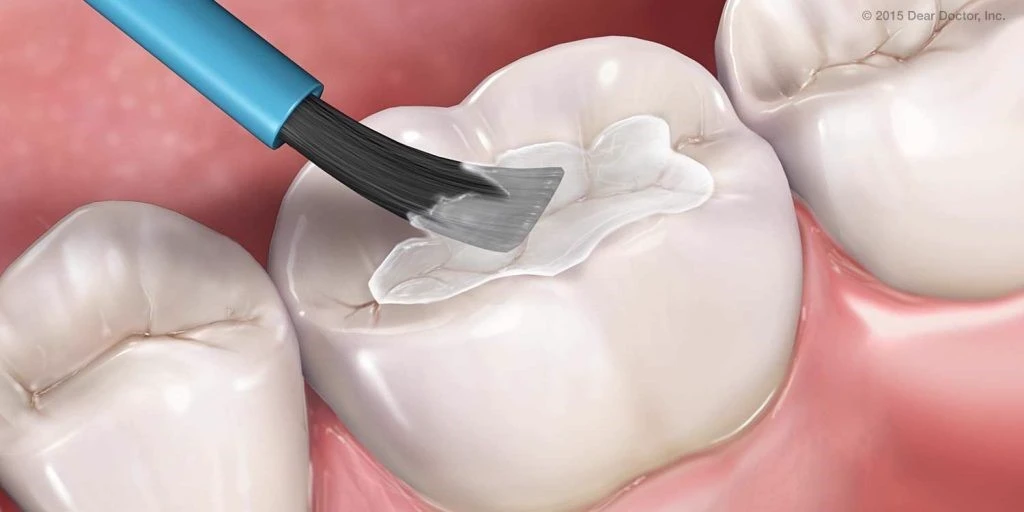
Sealing is carried out by the dentist, who brushes and thoroughly cleans the grooves of the teeth. Once cleaned and dried, the grooves are filled with a special gel that prepares the tooth for the sealant. The next step is to apply the sealant, which creates a real barrier and prevents food and bacteria from building up. The final stage is to set the sealant using a curing light.
Who can have fissure sealing?
In theory, it is a decay-prevention method that can be carried out for all patients, of any age. In general, however, it is reserved for children, as they are the most exposed to attack by the harmful bacteria that damage tooth enamel.
As this is a preventive technique, we recommend sealing your children’s teeth as soon as the first permanent molars come through. It is important to know that, for the grooves and pits to be sealed, the teeth must be completely healthy and show no sign of decay in progress.
The advantages of fissure sealing
- Fissure sealing prevents oral disease. The greatest benefit of applying sealant to the teeth is the prevention of oral disease, dental infections and bad breath, because the sealant reduces the build-up of plaque and food debris on the surface of the teeth.
- Fissure sealing makes teeth easier to clean. As we have already mentioned, the teeth are full of grooves, which makes brushing much more difficult. Sealing leaves the surface more even and ‘smoother’, so brushing is effective.
- Fissure sealing helps protect tooth enamel. Tooth enamel is the hardest structure in our body. Even so, through trauma, cracks and wear, it can expose the innermost part of the tooth, the dentin. Fissure sealing helps protect this layer and, as a result, the whole structure of the tooth.
Does fissure sealing hurt?
The procedure is completely painless and the patient feels no discomfort.
Now that you know all about fissure sealing and what the technique involves, don’t forget to book a check-up with your dentist. Prevention is always the only weapon available for avoiding dental disease and unpleasant toothache. For more information and advice, please contact our clinic: a team of professionals experienced in paediatric dentistry is ready to take the very best care of your children’s oral health!
Lasă-ne un comentariu